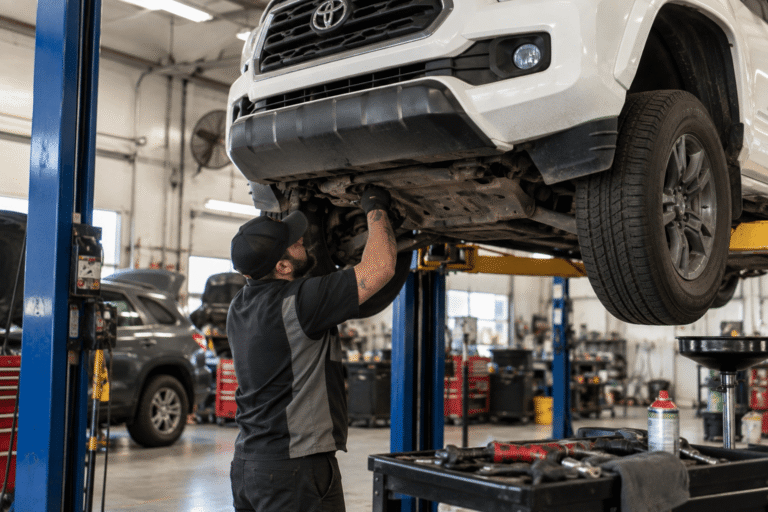

Toyotas outlast almost every other vehicle on the road. They still need work to get there. The Toyota maintenance schedule is what carries a Camry, RAV4, or Tacoma past 200,000 miles.
The big checkpoints fall at 30K, 60K, 90K, and 120K. Skipped services are the most common reason a sound Toyota dies early.
The data backs this up. The iSeeCars longest-lasting brands study looked at more than 395 million vehicles. Toyota ranked first, with a 19.7% chance of reaching 250,000 miles.
In the same iSeeCars data, the average vehicle had a 5.4% chance. Flip Toyota’s number around. About four in five Toyotas still never make it.
Parker Automotive has serviced Toyotas in Tucson since 1995. Here is what each major service covers, what fails when owners skip it, and how to catch up.
Why Toyota owners assume their car needs nothing
A good name can hurt a Toyota. Four habits cause most of the harm.
- The engine hides damage well. Toyota builds in wide margins. A worn engine keeps running well long after damage starts.
- Free service ends right before the big one. ToyotaCare covers basic maintenance for 2 years or 25,000 miles. The first major service lands at 30,000 miles, after the free visits stop.
- “Lifetime” fluid sounds like “never.” Toyota lists transmission fluid as inspect-only under normal use. Many owners read that as no service at all.
- No dash light warns you. A seeping water pump or a stretched belt gives no alert until it fails.
What Toyota’s maintenance schedule includes at 30K, 60K, 90K, and 120K
Toyota builds its schedule on 5,000-mile or 6-month steps. The larger services stack on top.
The items below come from Toyota’s 2024 Camry Warranty & Maintenance Guide. Your model and engine may differ, so check your own guide or bring your VIN.
30,000 miles or 36 months
- Replace the engine air filter and cabin air filter. See our air and cabin filter replacement service.
- Change the oil and filter, and rotate the tires.
- Inspect brake pads, rotors, lines, and hoses as part of a brake inspection.
- Inspect ball joints, drive shaft boots, steering linkage, exhaust, fuel lines, and coolant.
- Check the transmission and its cooler hoses for leaks.
Toyota 60,000-mile service
The 60K visit repeats the full 30K list and adds three items.
- First drive belt inspection, then every 15,000 miles after. We check belts and hoses together.
- New spark plugs on the 3.5L V6 (2GR-FKS engine).
- New transmission fluid if you tow, haul heavy loads, or idle for long periods.
90,000 miles or 108 months
The 30K list runs again. On older V6 and V8 Toyotas with timing belts, this is also the belt and water pump interval.
Coolant comes next. Toyota calls for the first coolant change at 100,000 miles or 120 months, then every 50,000 miles.
120,000 miles or 144 months
- New spark plugs on the 2.5L four-cylinder (A25A-FKS engine).
- New brake booster vacuum pump on the 3.5L V6.
- Filters, oil, tire rotation, and the full inspection list again.
What breaks when Toyota service intervals get skipped
Skipped services rarely cause one big failure. Wear builds up until one part takes others down with it.
Water pump
Toyota’s pink Super Long Life Coolant protects the water pump seal. Old coolant carries debris. Debris between the seal faces lets coolant slip past and drip from the weep hole.
The first sign is often a pink crust below the pump.
Toyota issued a service bulletin, T-SB-0103-20, to help technicians tell harmless staining from an active leak. That check happens at each major service.
Miss it, and a failing pump can overheat the engine and warp a cylinder head. That turns a pump job into engine repair.
Timing belt and timing chain
Most Toyotas built since the mid-2000s use a timing chain. Chains last far longer than belts. They still depend on clean oil to keep the tensioner and guides working.
Older Toyota engines use a belt. That list includes the 3.0L 1MZ-FE and 3.3L 3MZ-FE V6 engines. It also includes the 4.7L 2UZ-FE V8 in the Tundra, Sequoia, and 4Runner.
Toyota calls for a new belt at 90,000 miles. The water pump runs off that belt, so both get replaced together. On some of these engines, a snapped belt lets the pistons strike the valves.
Transmission fluid neglect
Toyota’s WS fluid is inspect-only under normal driving. The guide says to replace it at 60,000 and 120,000 miles under hard use. That means towing, heavy loads, or long stretches of idling.
Pulling a trailer up the Catalina Highway counts.
The guide also notes that your shop may recommend service based on what the inspection finds. Dark fluid or a burnt smell means it is breaking down.
Catch it early, and a fluid service fixes it. Wait, and you may need transmission repair.
Carbon buildup on direct injection engines
Carbon buildup is less of a Toyota problem than most blogs claim. Most current Toyota engines use D-4S, which pairs direct injectors with port injectors. The port injectors spray fuel across the intake valves and help keep them clean.
The real exception is the 2.5L 4GR-FSE V6 in the Lexus IS250. It uses direct injection only, and it is known for carbon on the intake valves. Owners notice a rough idle, misfires, and lost power.
If you drive one, ask about it during Lexus service. For any Toyota, on-time oil changes cut the oil vapor that feeds carbon. Fuel delivery problems fall under fuel system repair.
Tucson driving and Toyota’s special operating conditions
Toyota publishes extra services for hard use. The guide says they apply only when most of your driving happens under these conditions:
- Dirt or dusty roads
- Towing, a roof carrier, or heavy loads
- Extended idling or low-speed driving
- Repeated short trips below freezing
If you live off a dirt road in Marana or the foothills, the dusty-road schedule likely fits you. It moves oil changes to every 5,000 miles and adds air filter checks at each visit.
A paved commute across town usually stays on the standard schedule. Extreme heat is not a listed condition. Heat still ages fluids and rubber, so regular inspections matter here.
How to get a high-mileage Toyota back on schedule
Missed a few services? Start here.
- Pull your model’s guide from Toyota’s owner manuals page.
- Gather your service records.
- Bring both to a shop for a multi-point vehicle inspection.
- Handle coolant, belts, and fluids first. Those protect the engine and transmission.
- Set reminders for every 5,000 miles or 6 months going forward.
Schedule Toyota service in Tucson
Parker Automotive follows Toyota’s factory intervals and tells you what can wait. Our ASE-certified technicians back the work with a 36-month, 36,000-mile nationwide warranty.
Learn more about our Toyota repair and maintenance or see our full list of auto repair in Tucson services.
Book your Toyota service online or call (520) 323-1960. Visit us at 5101 E. Speedway Blvd., Tucson, AZ 85712.